Choosing the best Rubber Vinyl Tiles in 2026 requires more than comparing colors and prices. A floor may look attractive under showroom lighting, yet fail beside a busy entrance. Foot traffic, moisture, cleaning routines, and subfloor condition all influence long-term performance. A useful evaluation should examine wear-layer thickness, dimensional stability, slip resistance, acoustic comfort, and installation requirements. Small details matter. A tile that feels firm under a shopping cart may respond differently in a humid basement.
Reliable decisions should begin with manufacturer datasheets, test reports, warranty terms, and installation guidance. Look for clearly stated performance ratings rather than vague claims such as “commercial grade.” Independent testing can help verify abrasion resistance, fire behavior, emissions, and dimensional consistency. Regional standards may differ, so buyers should confirm requirements with qualified local professionals. Adhesive compatibility also deserves attention. The wrong adhesive can cause curling, staining, or movement after installation.
No tile is perfect. A thicker product may offer better comfort but increase transition problems at doorways. A textured surface can improve grip, yet collect more cleaning debris. Recycled content may support sustainability, but its quality and documentation should be checked carefully. Experienced installers often identify issues that product brochures overlook, especially uneven subfloors and poor moisture control. This guide will compare practical options for homes, offices, retail spaces, and light commercial areas. It will also question popular assumptions, because the cheapest choice is rarely the most economical over several years.
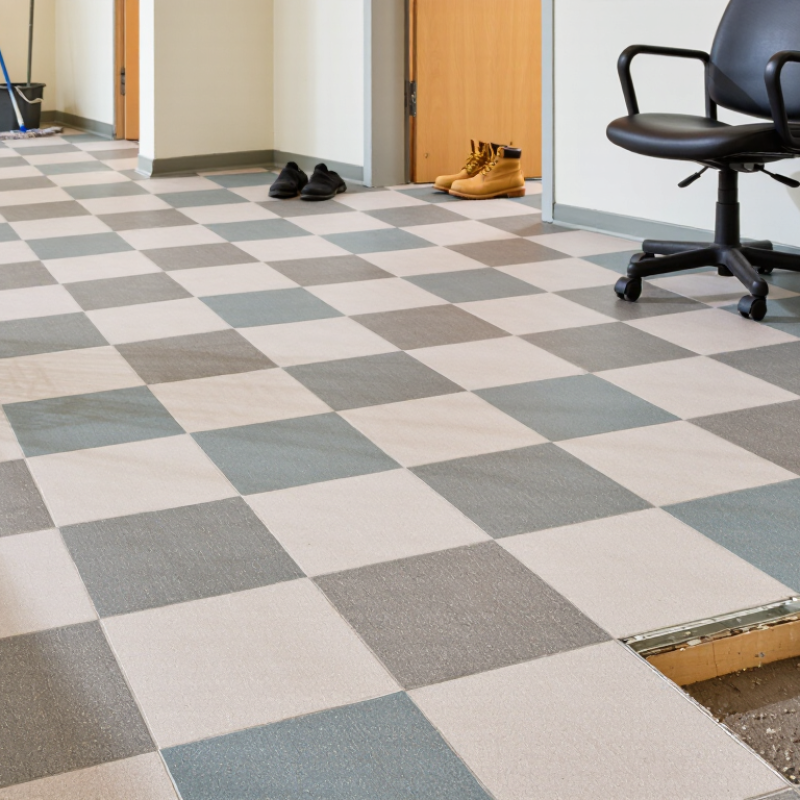
Rubber vinyl tiles are resilient flooring units made from vinyl polymers, rubber modifiers, mineral fillers, pigments, and stabilizers. The term is not fully standardized, so specifications matter more than the label. ASTM F1700 covers vinyl composition tile, while ASTM F1344 addresses rubber floor coverings. A product described as “rubber vinyl” may behave differently from pure rubber or pure PVC.
Main performance features include abrasion resistance, indentation recovery, dimensional stability, slip resistance, and acoustic comfort. The wear layer protects printed surfaces from carts, grit, and repeated footsteps. Moisture testing is equally important. ASTM F2170 measures concrete’s internal relative humidity, while installation limits commonly range from 75% to 85% RH, depending on the adhesive system. The U.S. Environmental Protection Agency reports that people spend about 90% of their time indoors, making low-emission flooring a practical concern. Look for tested VOC emissions, not vague “green” wording. Higher ratings are not automatically better. I learned that the hard way with overly rigid tiles that telegraphed small subfloor defects.
Tips: Request ASTM test results, wear-layer thickness, slip data, and installation limits. Check a sample under strong side lighting. It may reveal curling, color variation, or a fragile surface. Choose textured tiles for wet zones, but remember that deep textures can trap dust and increase cleaning time.
Choosing between rubber and vinyl starts with the room’s demands. Rubber tiles handle impact, noise, and repeated foot traffic well. Vinyl tiles offer many printed patterns and often resist everyday stains. In fitness rooms, textured rubber improves grip under damp shoes. In offices, smoother vinyl allows chairs to roll more easily. Check the tile’s wear layer, slip rating, and indoor-air documentation before buying. A low price can hide weak edges or strong odors.
Texture affects cleaning and comfort. Fine embossing adds traction but can trap grit near doorways. Deep studs suit utility areas, yet they may feel tiring under standing desks. Smooth surfaces look neat, but water becomes harder to notice. Common sizes include 12-by-12-inch, 18-by-18-inch, and larger square formats. Small tiles simplify replacement around damaged spots. Larger tiles create fewer seams, though uneven floors become more visible. Measure the room carefully. Small errors multiply across a full floor.
Installation depends on the subfloor and future use. Interlocking tiles install quickly and can be lifted later. Adhesive-fixed tiles feel stable, but the concrete must be clean, dry, and level. Loose-lay tiles reduce preparation, although edges may shift in busy zones. Leave the materials in the room for at least 24 hours before cutting. This allows temperature adjustment. I would not choose texture from a screen alone; samples can feel surprisingly different. Review the installation guide, test a small area, and accept that the perfect option may require a compromise.
Durability starts with the room’s real workload, not the product brochure. Check wear-layer thickness, dimensional stability, and residual indentation results under ASTM F970 or ISO 24343-1. High-traffic corridors need stronger abrasion resistance than quiet bedrooms. The U.S. Environmental Protection Agency reports that indoor pollutant levels can be two to five times higher than outdoor levels. Select low-emission flooring, and request current test documentation rather than relying on vague claims.
Safety requires more than a textured surface. Ask for wet and dry slip-resistance data, tested under recognized methods such as ASTM F2913. The CDC reports that more than one in four adults aged 65 and older fall annually, so a forgiving, stable surface matters. Avoid sharp edges and poor transitions. Small height changes can become painful surprises.
Comfort depends on impact absorption, sound, and standing time. Rubber tiles often feel warmer and softer underfoot, while vinyl can simplify cleaning. Maintenance should match the site: sealed seams, neutral cleaners, and routine debris removal reduce staining and premature wear. I once prioritized appearance over cleaning effort. That shortcut was wrong. A beautiful tile becomes frustrating when dust collects in deep texture or replacement batches vary noticeably. Ask for spare tiles and a written maintenance schedule before purchase.
Choosing rubber-vinyl tiles in 2026 starts with the room, not the color chart.
ISO 10874 classifies resilient flooring by use intensity: residential 21–23, commercial 31–34, and industrial 41–43. A quiet bedroom may suit Class 21. A school corridor needs stronger wear resistance. Do not over-specify blindly. Extra thickness can raise costs without solving rolling loads or moisture.
Traffic should be translated into measurable stress. Count daily users, trolley wheels, wheeled chairs, grit, and cleaning cycles. ASTM F970 static-load testing helps compare indentation resistance. However, its result does not promise unlimited service. Healthcare rooms need tight seams, chemical resistance, and slip performance during wet cleaning. Entryways need protective mats. Skipping them is an avoidable design error.
Usage conditions often defeat a good tile. Bathrooms and below-grade rooms require moisture control, a dry substrate, and adhesive compatibility. The U.S. EPA’s indoor-air-quality guidance reports that indoor pollutant levels can be two to five times higher than outdoors, so low-emission documentation matters. Ventilation helps, but it cannot rescue poor installation. Review ASTM or ISO test reports, not vague claims like “heavy duty.” I would request a sample, roll a loaded chair across it, and inspect the seam after cleaning. Real floors are less forgiving.
Choosing rubber vinyl tiles in 2026 requires more than comparing the price per square metre. Ask for the complete installed cost. Include subfloor repairs, adhesive, delivery, cutting waste, and future maintenance. A cheaper tile can become expensive when uneven floors demand extra preparation. Request a written quotation with every charge listed. Keep a small replacement allowance.
Environmental information should be specific, not decorative. Check recycled content, manufacturing location, product lifespan, and end-of-life options. Environmental Product Declarations can reveal impacts across the tile’s life cycle. Also request indoor-air-quality test results and installation guidance for emissions control. Recycled content matters, but durability matters too. Replacing worn flooring repeatedly may create a larger burden. This part is easy to overlook.
Supplier quality often separates a reliable purchase from a frustrating one. Order samples and inspect colour, edge accuracy, surface texture, backing, and slip performance. Ask whether production batches remain consistent. Request independent test reports, warranty terms, technical data, and traceability records. A dependable supplier explains limitations instead of promising everything. Check response times before paying. Slow answers may signal weak after-sales support. I would also confirm stock availability and delivery protection. One damaged shipment can delay an entire project. No supplier is perfect. My own buying checklist would still include two competing quotations, because attractive samples can hide uncertain service quality.
Typical North American planning ranges show that vinyl composition tile usually has a lower installed cost, while rubber tile generally offers higher impact resistance and comfort. Before buying, compare the full lifecycle cost, recycled content, product emissions documentation, environmental product declarations, warranty terms, batch consistency, test reports, and supplier quality systems such as ISO 9001. Actual prices vary by region, subfloor preparation, installation complexity, and order volume.
Cost ranges are typical market-planning estimates in USD per square foot and should be verified with current regional quotations.